|
Next, I am drawn to two drawings by Margaret Harrison. One is a robotic-looking graphite and watercolor piece titled Captain America with Frankenstein-like overtones and a wide open vulva.
Suddenly, my mind is thinking back to the underground newspaper The Student Voice I edited in high school. At the time, 1970, I was a freshman. A talented young woman who was then in her senior year submitted a poem that I published. It included the words Touch me, I have a burning separation.
That line in my underground newspaper inflammed a conservative member of the suburban community of Ferndale, Michigan where I attended school. At a Board of Education meeting where I was proposing a Ferndale High student-ratified constitution for our United Student Assembly, she labeled it pornographic. Then she called out about me, "He's a Communist!"
On the walls of the WACK! exhibition another
Margaret Harrison piece catches my eye. A woman clad in black lingerie rides on top of a banana that is twice as
large as she is. It is titled "Banana Woman".
ALLENDE proclaims one of the
twelve "books" in "Dairy of Objects of Resistance" created in 1973 by an
English woman.
I search for the artist's name, but I
don't see it in the display case that seems to be skimmed over and forgotten by
other visitors. The reason I put the word "books" in quotation marks is because
these are items that few would readily describe as books, but which the woman who
created them designed to be easily hidden from the Chilean authorities and to be easily transported as the
artist was always on the move.
The objects she created take us inside her experiences as a British socialist during the early days of the
period when the military overthrew democratically elected President Salvador Allende in June of 1973. As many know, they did
so with encouragement from the U.S. Central Intelligence Agency and the Chilean
right wing.

Martha Rosler's "Hot House" aka "Harem" is a photo collage of Playboy playmates and women from
magazine bra ads assembled into a nude harem.
"Intercourse with..." are the words I hear first on the audio when I put on an artist supplied pair of headsets while pondering a multicolumn list of names. The
audio, compiled from the phone machine messages received by Hannah White,
includes calls from everyone from Francis Ford-Coppola and Claus Oldenburg to a
man who says he has dialed a wrong number that (my guess) calls back later as a
"Heavy breather."
Hannah also appears in her own
video monologue. She is seen from the waist up, talking while topless and perhaps
bottomless as well.
Oh the things you can do with
panty hose! I'm looking at an abstract corner installation made in 1977 by
Senga Nengudis, titled "Nylon mesh and sand."
Senga's panty hose are filled in the hip,
crotch and butt area with varying quantities of sand, with the legs stretched
super long upward in large "V" shapes and nailed to walls. I see a series of
female back sides from buttocks to shoulders in this work and envision these
women with arms stretched up in a V vulva shape.
Next, in "Carving" by Eleanor Antin, the artist shows herself in four rows of forty black and white images each,
standing nude, mug-shot-like, in front of a white door as she strives to
carve weight from her body via a weight loss regime.
I come closest as an artist to
the works I see before me by Joan Semmel. Her oil paintings feature her
perspective of her body (larger than-life size) lying next to someone presumed
by their proximity to be her lover.
Rounding a corner, the work of
another collage artist appears. I particularly like this one. It is by Mary Beth Edelson in 1976.
Her work is titled "Death of Patriarchy/Heresies." It depicts the faces of the artist and her
A.I.R. girlfriends pasted over those of individuals in a painting of French
revolutionaries that seems familiar, so I assume the original is famous and
hanging somewhere in the Museum
The only men shown in this piece by Mary Beth are dying on the ground or already lying prone.
Next to the work referenced
above, is Mary Beth's 'Bring Home the Evolution," featuring a similar scene to
the one just described, except this one is familiar from somewhere in the
American history recesses of my mind.
Perhaps the original work depicts Ethan Allen and the Green Mountain Boys (or some such revolutionary expeditionary
force) hiking toward us on a mountain road. Mary Beth's version has the faces
of women who at the time she created it were working to achieve an Equal Rights
Amendment (ERA) for women.
I stand in front of this work,
recalling how the ERA passed both houses of Congress and was ratified by many
states, but after a long struggle failed to achieve ratification by the number
of states required to amend it to the U.S. Constitution.
And I give a hip-hip hooray for
Mary Beth's "Some Living American Women Artists," which portrays Georgia O'Keeffe
sitting in Christ's seat in a recasting of Leonardo da Vinci's The Last Supper
surrounded by other women whose faces I don not recognize.
An overwhelming realization
comes over me as I pause after viewing what I figure is one-third of the art
works on display at WACK! Most of the
works featured are from the sixties and seventies. Cataloging what I have seen
in my mind I consider it probable that the collection reflects a curatorial
constriction of the works shown.
I get the impression of a great
fluorescence of feminist and/or female artistic expression and exploration
during two liberating decades, but begin to wonder about what women in the arts
have been up to since then.
Speaking of X-perimentation,
there is exploration by the women whose art is displayed in the WACK! exhibition, of themes that in
other venues might grab an X-rating, be labeled as porn, or perhaps banned due
to community sensibility for X-plicit themes. One artist, Cosey Fanni Tutti,
actually infiltrated the porn industry as a performer "to subvert the medium's
power of subjugation."
If one had access to Tee
Corinne's "Cunt Coloring Book" and colored in the images presumed to be inside,
you could come up with a reasonable facsimile of a Georgia O'Keeffe flower
image. Fortunately the coloring book is sealed inside a glass display case, so
any impulse to color flower-like vaginal openings and labia remains interior
within my mind.
Now I am sitting on stacked up
mattresses inside a square structure formed from floor to ceiling (walls included) by
mattresses attached to an aluminum pipe structure. The work was created by Marta Minujin
and Richard Squires and is called Soft Gallery. Inside it, I am being bounced on the
mattress by the steps of people who have come in after me to watch a video by a
female artist on a TV. The television is the only other thing in the room besides
people (mostly women) and mattresses.
I cannot see the TV for all the
female bodies bouncing with me. I am the only man bouncing on these mattresses. The show in
the room is compelling, but I move on.
On a wall outside the mattress
room, artist Bonnie Ora Sherk really catches my attention. Back in the 70s she
created a communal farm under an overpass in and her big mixed-media mural
in front of me offers a layout of the farm with photos varnished on it and
various notes written. I wish for many more of these places in the green world
of our future. I make a mental note see what her place is like now the next
time in Frisco. And I find myself wishing that I had been a part of its creation
back in the 70s. Sherk's series of works ends in 1980. Wonder what she is up to
now?
Back in the mattress room, now
less crowded, I see that the video is of a protest "mourning the reality of
violence against women." The protest seeks respect for the rights of women who
have been raped and abused. I wonder if we have made progress since this protest was
held, thinking first about how corporations are now offering training to prevent
sexual harassment and firing employees who are found guilty of it. Then I think
about how the police and the judiciary are now much tougher on rape and no
longer blame the victim. However, my next thought is about how much more needs
to be accomplished throughout the world to protect the rights of women.
Large black and white photos
show Mierle Laderman Ukeles and her two male colleagues cleaning the display
case of a female Egyptian mummy back in 1973. The work is titled "Transfer: The
Maintenance of Art Objects." I have a lot of thoughts about Ancient Egypt in rapid succession, but decide they are too many and not relevant to the rest of the exhibit and so do not write them.
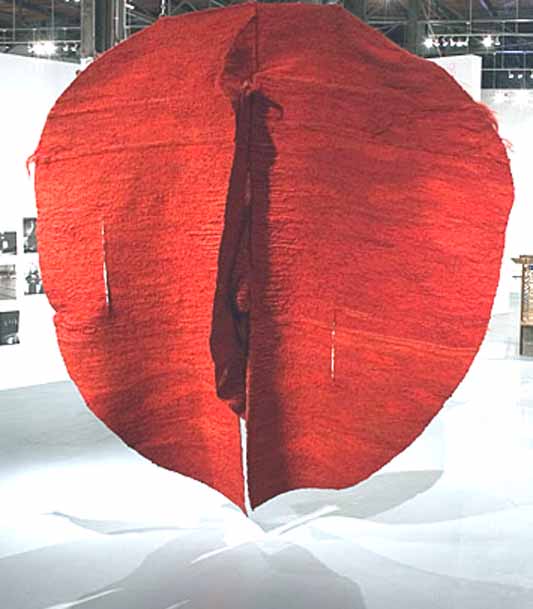
Last up in the exhibition is a display, near the exit and thus the entrance with its sisal labia,
is a model of Hon by Niki De Saint Phalle.
She is laying on her back, legs bent, feet grounded, with steps leading up to her oval vaginal hole,
the entrance to what was, as the wall size picture next to Hon reveals, a large-scale work.
for a 1966 exhibition at the Moderna Museet in Stockholm, Sweden.
My first impression upon hearing
about the installation and seeing the mockup is that Niki is referencing the
ancient prehistoric structures that some archaeologists suggest may have been
meant as exactly the same pregnant woman on her back. Was Niki's colorful work a
reference to these amazing prehistoric structures?
As I stand gazing at the Hon
mockup by Niki De Saint Phalle from a vantage point between her legs, an art educator
who I previously noticed leading to a large tour group comes on a direct route
to me.
"I have to ask you, what are you
writing?"
I struggle for the words to
describe the experiences I have had wandering WACK! With a lack of articulate
phrasing that surprises me, especially given the intensity of the thoughts
that have run through my mind, I briefly explain the goddesses.com web site and
wonder if I could ask her a few questions about the exhibit.
She consents.
Q: What it seems is that the
exhibition is focused on works by female artists of the 60s and 70s. Why?
A: They had thought about
including the 50s, but the 60s and 70s was when everything came together.
Q: What happened afterward in
the 80s?
A: The 80s were a time of focus
on diversity, inclusion. Hip hop artists and graffiti artists took center
stage.
Q: In truth, aren't most of the
artists represented here white women?
A: No. Look right here. This documents
the performance art of black woman who wore this dress made of white gloves
into all white establishments. She was focused on breaking down and challenging
color barriers.
Q: The Hon work seems
to reference some prehistoric tombs shaped like the
pregnant bellies of Mother Earth that were entered through vulva-like openings, and
vagina-like passages that led to womb-like tombs. I wonder whether Niki de Saint Phalle
was inspired by them.
A: Niki de Saint Phalle was very
well-educated and well-read on many subjects. She may well have been inspired by
these places.
I begin to confess to her about how my adolescent awakening
came about concurrent with fantasies I termed within my brain The Naked Ladies Club,
and that it was drawing that group of fantasies out through my pastel artworks that
led me to an interest in prehistoric archaeology. But then, several people who had been talking
with the art educator previously, come along to engage with her again.
She catches my eyes a couple minutes later when I look up from my continued examination of the Hon display.
I take the opportunity to ask her one last question.
Q: Is Los Angeles the only venue,
or does the WACK! exhibition now go on tour?
A: WACK! goes to Washington D.C.
next, then on to PS1 in New York City and to Vancouver after that.

|